


Emu Oil
What Is Emu Oil?
 Emu oil is an animal-derived oil obtained from the fat of the emu (Dromaius novaehollandiae), a large flightless bird native to Australia. Emus can reach around 6 feet in height and are raised commercially for meat as well as co-products such as leather and oil.
Emu oil is used primarily in topical skin-care products, massage oils, creams, lotions and other cosmetic preparations. It is rich in fatty acids, particularly oleic acid, and also contains linoleic acid and several saturated and unsaturated fatty acids.
Although emu oil has a long history of traditional use and has attracted scientific interest for its possible moisturizing, anti-inflammatory and skin-penetrating properties, many commercial claims about the oil go considerably beyond the available human clinical evidence. It is better viewed as an unusual cosmetic and topical oil with interesting biological properties rather than as a proven treatment for a long list of medical conditions.
History and Traditional Use of Emu Oil
The use of emu fat in Australia long predates the modern commercial emu-oil industry. Historical accounts describe Aboriginal Australians using emu fat as a topical preparation, including as a salve to protect the skin and for traditional medicinal purposes.
Later European settlers in Australia also adopted various uses for rendered emu fat. Historical reports describe emu oil being applied to the skin, bruises, sprains and aching joints, as well as being used for practical purposes such as leather treatment and lamp fuel.
Modern scientific interest in emu oil grew from this history of topical use. Experimental research has investigated its fatty-acid composition, possible anti-inflammatory activity and ability to function as a carrier for substances applied to the skin, although much of this research has involved laboratory or animal models rather than large human clinical trials.
For background on the traditional use of emu fat, see this research review of emu oil and Aboriginal medicine.
How Emu Oil Is Produced
Emu oil is obtained from fat that is a co-product of emu processing. The fat is separated from the bird and rendered to release the oil. The crude oil can then undergo additional processing to remove water, solids, impurities, odor and other unwanted components.
The exact refining process varies among producers. Modern commercial processing may include rendering, filtration, refining, bleaching or deodorization, but there is no single refining method that all legitimate emu oil must follow.
The American Emu Association specifically states that it does not endorse one particular refining technique. Instead, its quality standards focus on whether the finished oil meets defined chemical and physical specifications.
Emu Oil Quality Standards
Because emu oil products can differ substantially in purity and processing, quality is more useful to evaluate through specifications and testing than through claims such as “ultra,” “premium” or “pharmaceutical quality.” Those terms may be used differently by different manufacturers.
The American Emu Association (AEA) has developed trade rules that define three grades of emu oil:
- Grade C – Crude Emu Oil: minimally processed oil intended for further processing or applications such as soap and some industrial uses.
- Grade B – Once Refined Emu Oil: refined oil that may be used in certain topical and cosmetic formulations.
- Grade A – Fully Refined Emu Oil: oil meeting the AEA’s most stringent specifications.
Only pure Grade A oil that meets the additional requirements of the association’s certification program can legitimately carry the AEA Certified Fully Refined designation. Certification involves independent testing of a production batch and other quality-control requirements.
You can read the current American Emu Association Emu Oil Trade Rules and information about the AEA Certified Emu Oil Program.
Types of Emu Oil Products
Pure refined emu oil is sold as a liquid or semi-solid topical oil, but emu oil is also used as an ingredient in a wide variety of cosmetic products, including creams, lotions, soaps, shampoos, conditioners, lip products and massage preparations.
Terms such as “ultra,” “ultra clear” or “premium” are not universal scientific grades. When comparing pure emu oils, the AEA Grade A, B and C system is a more clearly defined classification where applicable.
Consumers comparing products can look for clear ingredient labeling, batch information and evidence of appropriate quality testing rather than assuming that a marketing term by itself indicates superior purity.
Emu Oil Composition
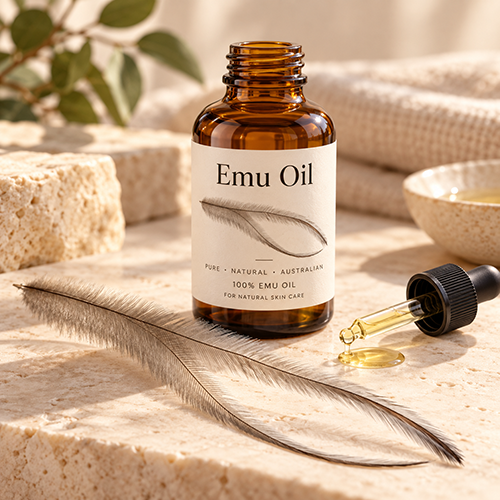 Emu oil contains a mixture of fatty acids, and its precise composition can vary depending on factors such as the bird’s diet and the processing of the oil. Research has consistently found substantial amounts of oleic acid, a monounsaturated omega-9 fatty acid, together with linoleic acid and saturated fatty acids such as palmitic acid.
This means that emu oil is not compositionally equivalent to fish oil. Marine fish oil is particularly valued for the long-chain omega-3 fatty acids EPA and DHA, whereas the dominant fatty-acid profile of emu oil is quite different.
A modern chemical analysis of emu oil found high amounts of oleic and linoleic acids and examined several other physicochemical characteristics of the oil. You can view the published emu oil composition study.
If you are comparing the fatty-acid profiles and culinary or cosmetic uses of different oils, you may also be interested in macadamia oil, safflower oil, sunflower oil, flaxseed oil and rapeseed oil. These oils have distinctly different fatty-acid profiles and should not be treated as nutritionally interchangeable.
Properties of Emu Oil
Emollient and Moisturizing Properties
Like many lipid-rich topical oils, emu oil acts as an emollient. It can soften the skin and reduce the dry or rough sensation caused by loss of surface lipids. Its high oleic-acid content also contributes to the way the oil spreads across and interacts with the skin.
Skin Penetration
Emu oil has attracted interest as a possible penetration-enhancing carrier for topical ingredients. Oleic acid itself is known to influence the barrier properties of the outer layer of skin, and experimental formulations have investigated emu oil as part of topical drug-delivery systems.
However, the old explanation that emu oil penetrates deeply because it “contains no phosphorus” is not a scientifically useful description of skin absorption and should not be used as a reason for choosing the oil.
Possible Anti-Inflammatory Activity
Animal and laboratory studies have reported anti-inflammatory effects from some preparations of emu oil. An important detail is that the activity has varied substantially among different samples, suggesting that composition and processing matter.
These results are scientifically interesting, but they do not establish emu oil as a clinically proven treatment for arthritis, injuries or other inflammatory diseases in humans.
Comedogenicity
Emu oil is widely used in skin-care products and has historically been described by the emu industry as non-comedogenic. Individual skin responses can nevertheless vary, and people who are prone to acne or irritation may prefer to test any new topical oil on a small area first.
Emu Oil Uses
Dry Skin and General Skin Care
The most straightforward use of emu oil is as a topical emollient. Pure oil or cosmetic products containing emu oil can be applied to dry skin to provide lubrication and reduce the feeling of dryness.
As with other cosmetic oils, this should be distinguished from treating eczema, psoriasis or another diagnosed skin disorder. Those conditions have specific treatments, and the presence of a moisturizing oil in a product does not make it a medication.
Massage
Because it spreads easily across the skin, emu oil can also be used as a massage oil or as the lipid component of massage creams. Claims that it reliably relieves arthritis or chronic muscle pain, however, are stronger than the current human evidence supports.
Scars and Stretch Marks
Emu oil is frequently marketed for scars and stretch marks because of its moisturizing properties. Keeping skin moisturized can improve its softness and appearance, but there is not strong clinical evidence that emu oil can remove established scars or stretch marks.
Hair and Scalp
Emu oil is found in some shampoos, conditioners and scalp products. Experimental research has explored emu-oil formulations and hair-follicle activity, but the available evidence is not sufficient to say that pure emu oil prevents or reverses human hair loss.
One animal study using a formulation containing both emu oil and minoxidil reported increased hair-follicle activity, but this does not demonstrate that emu oil alone is a treatment for hair loss.
Wounds and Burns
Emu oil should not be presented as a proven wound-healing treatment. Research in this area is mixed. For example, one study of superficial burns in mice found that emu-oil-treated wounds healed more slowly and remained inflamed longer than untreated controls, although other tissue changes were observed.
Open wounds and significant burns should therefore be managed using appropriate wound care rather than by assuming that a natural oil will accelerate healing.
What We Actually Know About Emu Oil
Emu oil has an unusual history, a well-characterized fatty-acid profile and several properties that make it interesting for cosmetic and topical formulations. There is also legitimate experimental research into its anti-inflammatory activity and its use as a topical carrier.
At the same time, many of the dramatic claims historically used to market emu oil have not been established by high-quality human clinical trials. Claims that it removes wrinkles and scars, stops hair loss, treats arthritis, cures skin diseases or improves children’s health should therefore be treated cautiously.
The strongest reason to use emu oil today is much simpler: it is an emollient-rich topical oil with a distinctive fatty-acid composition and a long history of use, and it may be a useful ingredient in skin-care and cosmetic formulations.
Emu Oil Overview |
History |
Production |
Standards |
Types |
Composition |
Properties |
Uses